

Service Design
We apply service design methods to help organisations create and improve services that meet the needs of customers and support the goals and objectives of the organisation in a way that is efficient, effective and user-friendly.

Holistic service transformation
Service transformation encompasses a holistic approach to enhancing and redesigning a service across its entire value chain. This entails a meticulous evaluation and optimization of all facets, ranging from the customer experience to backend processes and systems, with the aim of elevating the overall service quality.
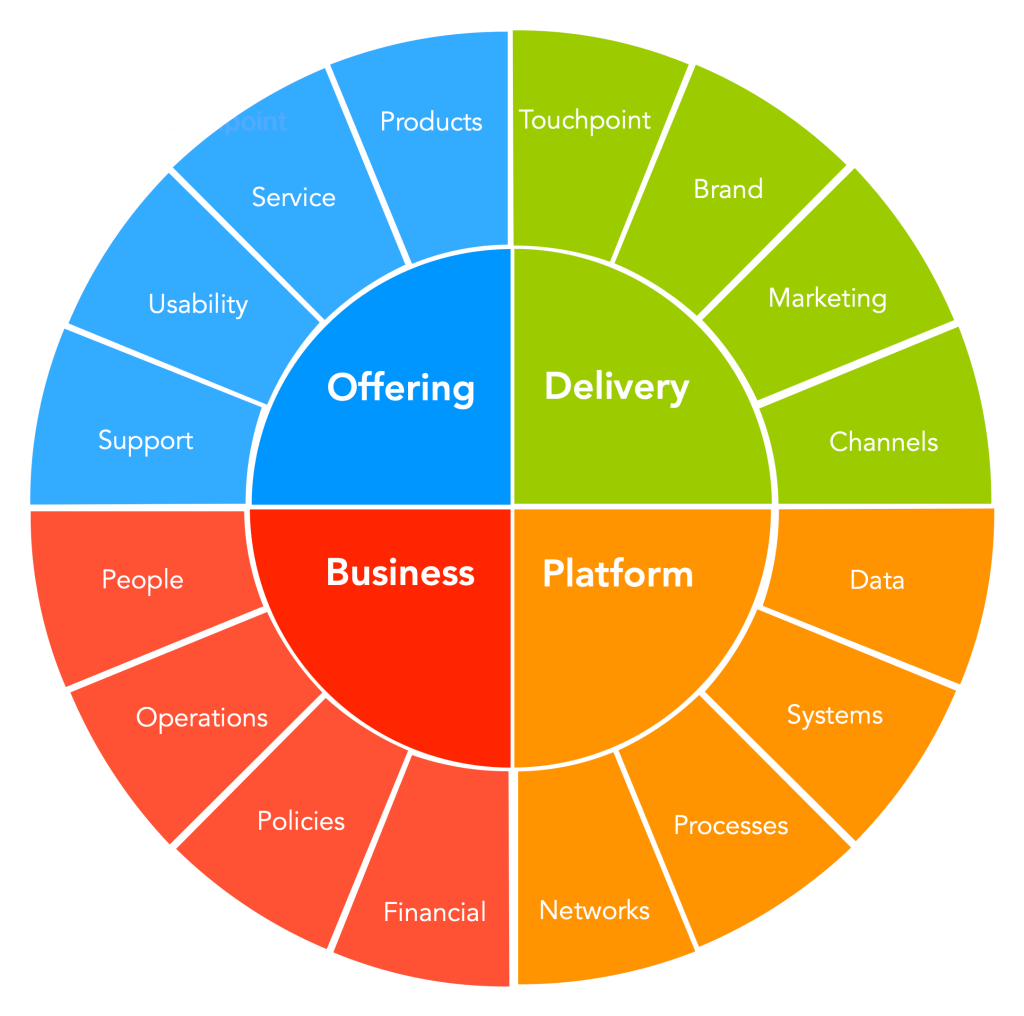
Our approach is structured around four key dimensions: the customer experience (Offering), customer engagement and outreach (Delivery), optimization of people and operations (Business), and leveraging technology and data (Platform). Employing a lean methodology, we foster collaboration to achieve ‘Value and Velocity,’ identifying areas with potential for valuable change and swiftly constructing service solutions to demonstrate their value in the marketplace.
The ultimate objective of an end-to-end service transformation is to cultivate a service that is more efficient, effective, and customer-centric, aligned seamlessly with the organization’s overarching business strategy. We firmly believe that transformation is an ongoing journey, not a one-time destination.
The Service Value Quadrants
We have developed an approach to identify change candidates that unlock value in four distinct value domains.
Offering is focused on the customer experience, value-in-use and value-in-exchange
Delivery is concerned with how to reach and engage with the customer.
Business is focused on culture and operations.
Platform is concerned with digital technology and associated systems including data.
All together there are 16 distinct value areas where we can focus our transformation efforts.
Connected Services
Increasingly services are connected and entangled. Complexity and interdependence can arise between different service components and processes. When different services are tightly linked together, it can create dependencies and interdependencies that can be difficult to manage and understand, leading to a range of problems.
We have developed an approach that enables an organisation to map these dependencies and interdependencies and identify where to focus efforts and reduce friction.
The Challenges
Dependence on other service providers
Complex service delivery chains
Interdependence between different service components:
Limited flexibility
Reduced scalability



 Factotum